Category: world of warcraft

  • World of Warcraft: Classic Will Outlive Retail & Its Clones

    World of Warcraft: Classic Will Outlive Retail & Its Clones

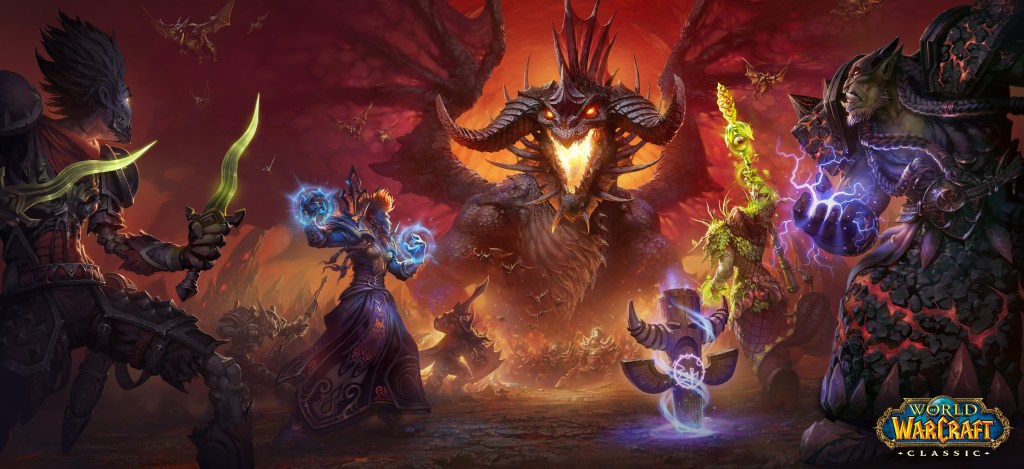
    World of Warcraft, the 800 lb gorilla of the MMORPG industry, has gained renewed popularity with the release of World of Warcraft: Classic, its subsequent expansions, and novelty servers. Even as the ashes of Activision Blizzard’s public reputation continue to smolder, Warcraft persists almost twenty years after its release. Despite having a new ‘retail’ expansion on the horizon, it feels that the longevity of WoW Vanilla will outlast not just its competition but its progeny as well whether Blizzard wants it to or not.

    Winter is Coming

    Massively multiplayer online role-playing games, like World of Warcraft, and Winter go together like blueberries and pie. For those living far enough from the equator for it to matter, the holiday season is cold, dark, and often lonely. Fantastic worlds of wonder and magic offer players an escape from their troubles and a “third place” to gather with other like-minded individuals. In search of a virtual world to make my home for the winter, I shuffled through my collection of MMORPGs to see what the space had to offer in 2023.

    Clearly, Final Fantasy is doing just fine. It’s not my cup of tea, but I’m glad folks are enjoying it and I wish I liked it more. Retail WoW offers me none of the joy that brought me to the scene as a child. Several new IPs have come and gone since I last paid for a Warcraft subscription, Wildstar, Rift, and Star Wars the Old Republic to name a few. The ones that were lucky enough to be put into maintenance mode offer me even less than World of Warcraft: the War Within. Other survivors market themselves as drastically different experiences, some attempting to recreate the magic of Ultima Online and others adopting a more action-oriented approach to combat. None of these experiences capture the fantasy of a massively multiplayer role-playing game: they’re unabashedly selling a product, showering new players in meaningless trinkets, and offering plenty more at the cost of an active monthly subscription.

    More Money, More Problems

    Money makes the world go round, but that’s not an excuse for bad game design. In an attempt to capture the success of World of Warcraft: Wrath of the Lich King, many competitors rushed out similar products without realizing what made the original worth its weight in gorilla. With employee turnover, the ravages of time, and some level of incompetence, Blizzard eventually began acting more like one of its own competitors rather than the company that launched the World of Warcraft back in 2004.

    Deathwing helped reshape Blizzard as well as Azeroth.

    Beginning with WoW: Cataclysm, it was clear that the world had changed, but not for the better. Blizzard stubbornly fought against private servers and their administrators for years, openly admitting that they thought they knew better than their fanbase. What they really knew is that, if players got what they really wanted, the stockholders would lose money. The original World of Warcraft was such a well-made carrot-on-a-stick that the players seem to prefer it over whatever gold-plated turd Activision Blizzard continues to serve their retail subscribers. Conceding to the inevitable, they eventually released their own vanilla servers called World of Warcraft: Classic.

    Exploring the World

    What is it about the original Azeroth that keeps players coming back? The “World.” Every other game, more modern expansions included, attempted to copy the success of WoW but forgot that the staying power of an MMO lies in its core fantasy. In World of Warcraft, the player starts off as a meager adventurer and must travel, go on quests, and meet other players and virtual characters. Reaching the max level in Vanilla was not the be-all-end-all goal popularized by later expansions. Role-playing, traversing the world, and chatting with other players are some of the most fulfilling experiences that MMORPGs uniquely offer, yet the industry quickly shifted to focus on end-game dungeoneering and selling premium fashion via microtransactions.

    Keeping the magic of an MMORPG can be a daunting task given they are intrinsically designed to keep the player playing as long as possible to soak up as many subscription fees as possible. Whatever Stockholm Syndrome that MMO fans suffer from comes with the urge to go back to the familiar and continue adventuring, but the illusion fades quickly once the player looks behind the metaphorical curtain. Despite the risk of scams, bots, and server admin drama, players flock to private servers to cut out the middleman and enjoy their favorite game however they want to.

    World of Warcraft is worth replaying over and over because there is enough going on across both continents to keep any sane person engaged for years. The game was designed to be explored. Even the most common form of fast travel, flight paths, zeppelins, and boats, force the player to stop and smell the roses. Open-world games are about setting one’s own goals, so results may vary, but as long as a player is comfortable making their own path, they’ll have plenty of adventuring to do.

    Retail World of Warcraft and plenty of other MMOs fail to fulfill their fantasies from the beginning; not only can players pay for max-level characters but they hardly start out as lowly adventurers. I have no interest in paying to become a renowned warlord of a virtual realm; A. because it saps the “accomplishment” of all its meaning and B. without meaning, there’s no point in spending my time chasing the proverbial carrot. Any game that offers a free max level boost on their in-game shop is conceding that a majority of the “game” is worth paying hard-earned cash to skip.

    World of Warcraft: Classic offers an experience that no other MMO can; everything matters (within reason). Delving into a modern MMORPG often involves dodging landmines and trying to avoid any gameplay that is outdated, underdeveloped, or otherwise obsolete. It’s a tedious process that WoW Vanilla avoids by being a time capsule of a better time rather than a half-baked hedonistic treadmill meant to milk players for every cent they’re worth. Cataclysm marked a clear delineation between the old Blizzard and the new; not only could you not go back to the old Azeroth anymore, but most of the Burning Crusade and Wrath of the Lich King (two popular expansions) became irrelevant. WoW Vanilla, TBC, and WoTLK give players a clear beginning and end with a static playing field to explore without fear of mistakenly playing a part of the game that no longer matters. Blizzard proved that plenty of players are willing to pay their developers to stop developing their games for the sake of endless growth and stockholder earnings.

    What do you think? Are there other MMORPGs that are doing something new and interesting? Let me know in the comments below.
  • 5 MMO Lessons from the Success of WoW Classic

    5 MMO Lessons from the Success of WoW Classic

    If you had told me in 2004 that in fifteen years World of Warcraft would be re-released to as much fanfare if not more than modern MMOs, I probably wouldn’t have believed you. At the time, WoW seemed like a natural extension of the success of Warcraft 3, but it would be impossible to correctly guess just how culturally significant the game would become. Even Blizzard, the company best known for adopting successful ideas and polishing them for a mainstream audience, didn’t see the prize-winning goose that they had sitting in their lap. “You think you do, but you don’t,” is the infamous line uttered by Allen Brack, now president of Blizzard Entertainment.

    Oops.

    As someone who played lots of World of Warcraft, both on retail and on a myriad of private servers, I scoffed when I first heard Mr. Brack’s condescending comment to Warcraft’s most devoted fans. “If that’s what they really thought about the fans of their original product, then screw them,” I thought. Thankfully, Blizzard came to their senses and released WoW Classic to a resoundingly enthusiastic response a few years later.

    And low and behold, the original World of Warcraft is rumored to be outperforming the retail version of Battle for Azeroth 15 years after its initial release. I hope Blizzard executives feel just a little guilty every time they cash their humongous checks from the success of WoW Classic. While they’re wallowing in their riches and cursing themselves for their complete lack of foresight, there are also a few other lessons that Blizzard and other MMO developers can learn from the success of the return to Azeroth.

    5. World Player Vs Player Content

    While open-world PVP has been fetishized by the MMO community to a dangerous degree over the past decade, there is a reason it has been generally phased out of modern game design: there are only so many sheep that are willing to be preyed on by wolves. Theme park MMOs like WoW thrive off of catering to as many players as possible, but whether it’s because of players queuing for dungeons in major cities rather than exploring the world or because the griefers chased away all their victims, world PVP just doesn’t feel the same anymore.

    Although I don’t think that the conflict between Tarren Mill and Southshore is the epitome of PVP action, there is something unique to WoW Vanilla that brings people back to the wilderness to either gank or be ganked. Perhaps it’s the glee of picking off enemy faction raiders, forcing them to reapply all of their buffs or picking off lowbie questers, but either way, it’s clear to see that WoW Classic fans were excited to jump back into the midst of old-school PVP chaos.

    4. Class Identities

    One of the biggest successes of WoW’s original design are the archetypal class fantasies that were ingrained in each specialization and talent tree. Nowadays, thanks to the constant “quality of life” improvements, most classes play similarly, most racial bonuses don’t matter, and the only real differentiating factor is how you’ve transmogrified your gear. Class-specific quests, class-specific raid utility such as Mage’s conjuring beverages, and non-combat abilities made each class/race combination feel unique and interesting.

    Sure, if you get down to the brass tacks, there isn’t much reason to keep non-combat abilities or class quests if your goal is to bring in as many new players as possible (many of which ignore all quest text and treat WoW like a murder simulator). However, filing down those edges has resulted in a bland, repetitive, and homogeneous experience. If some kid doesn’t like having to travel across the “world” to complete their quests, they can go play a game that isn’t explicitly about that very thing.

    3. Simplicity

    Games as a Service is a mixed bag in terms of its mutual benefit to both game developers and their fans, but one major issue with that approach is how quickly complexity creep starts to catch up with them. Having to release new content every few months to keep people subscribed results in bloated games that either force players to slog through years-old content or clear a clean slate every few years, all but erasing older content entirely. Either way, you slice it, MMOs have a complexity issue and going back to the very beginning when rocks were soft and games were simpler is bound to appeal to fans of older titles. Vanilla World of Warcraft isn’t a “simple” game by any means, but some players are more interested in proper positioning, preparation, and teamwork than how many buttons they’re required to press when executing their rotation.

    2. Gameplay Over Graphics

    Although retail Battle for Azeroth hasn’t strayed very far from its roots aesthetically, it’s clear that World of Warcraft’s initial success can at least partially be attributed to its ability to run on just about any machine back in 2004. Add an extra 15 years to that mix and you have a game that can probably run on your Apple Watch at this point, and yet, WoW Classic and Vanilla WoW’s popularity throughout the years has shown that good gameplay trumps graphics, at least in regards to long term longevity. A game’s graphics will look dated in 2-3 years, and that shelf life is only decreasing as technology improves. Blizzard instead took the success of Everquest, made it more accessible, and slapped on their signature stylized aesthetic and commitment to polish.

    1. Quality of Life Improvements Erode All Things

    World of Warcraft is a great lesson in how to draw the line between quality of life improvements and creating an immersive and believable world worth exploring. That is to say that Blizzard was really bad at dancing that line, instead deciding to leap even further past it with each new expansion pack. While there are many factors in an MMORPG’s loss in subscribers, many attribute the beginning of WoW’s decline to Cataclysm’s attempt at recreating Azeroth.

    Through a combination of dungeon finder queues, flying mounts, instanced single player areas, removing quests with any sort of scale or difficulty to them, removing class quests, favoring instanced PvP over Open World, and a myriad of other “features,” World of Warcraft became less and less about exploring the actual world of Azeroth and more about completing daily objectives, AoE clearing dungeons with a pickup group, and AFKing in the same exactly major city as everyone else despite the plethora of other interesting places to inhabit and explore.

    World of Warcraft Classic’s popularity is a clear lesson that some of the best parts of playing an MMORPG are overcoming obstacles with others. Remove the obstacles and any meaningful way to interact with strangers and you end up with a single player chat room simulator. Players are willing to put up with archaic game design decisions, dated graphics, and humongous time investments to play an MMORPG that actually plays like one.