Although Disney Pixar’s Onward isn’t the type of film that usually draws my attention, I was pleasantly surprised with the recent release on Disney+. Besides being a genius marketing strategy for their new streaming platform, Onward is also a wholesome and heartfelt road trip movie for the whole family starring Tom Holland and Chris Pratt.
The two brothers, Ian and Barley, live in a world very similar to our own except that it was once full of magic and wonder. Now that the magic is gone, however, capitalism has taken over, leading to the formerly-mystical creatures getting day jobs. The Lightfoot brothers, who just so happen to be elves, find themselves getting wrapped up in an epic quest with a surprisingly compelling twist. With stakes rapidly escalating, jokes throughout, and heartstrings being pulled like only Disney knows how, Onward completely shattered my expectations. Whether that’s because I had extremely low expectations to start with is still up for discussion.
Onward completely shattered my expectations. Whether that’s because I had extremely low expectations to start with is still up for discussion.
Without spoiling too much, Onward is set up as a very standard family-friendly animated flick but ends up taking some interesting creative twists that surprised and delighted. The fact that the story had so many emotional moments that hit close to home for me definitely helped. It’s hard to dislike a movie when you’re bawling your eyes out and clutching your significant other’s hand at the sight of two cartoon elves hugging. That’s got to take some kind of magic in and of itself, to be honest.
Although I enjoyed the movie, it’s definitely not without its flaws. Both Ian and Barley took a while to grow on me, which I partly attribute to the film’s pacing and writing. Chris Pratt is really the only actor given enough of a personality to warrant an especially expressive take, but his lines are wasted, at least at the beginning, on a lackluster Jack Black impression that he eventually grows out of. As Holland and Pratt are given more to work with, their performances drastically improve.
For the price of already having Disney+ to rewatch the Mandalorian and an hour and forty-two minutes of your time, Onward is the kind of wholesome, magical adventure that we all need in these difficult times.
While I’ve never officially studied law, I recognize the effects that intellectual property rights have had on the preservation of gaming history. This is why I’ve supported private servers for MMORPGs for years, namely because profits stand in the way of maintaining important video gaming artifacts as they were intended to be played. MMOs that have been long shut down by their copyright holders have found new life in private servers that often break the original game’s terms of use. One such game has benefited greatly from the popularity of a private server: Warhammer Online.
Like many MMORPG projects of the time trying to find their niche, Warhammer Online takes many of the best qualities from its predecessors and adapts them for a more PVP-focused approach. Although I didn’t have a chance to play it on its initial release, I’ve wanted to jump into the world of Warhammer for a long time to see what inspired some of my favorite features from Rift, another MMO from times gone by. Public quests, in particular, piqued my interest, as they offer a unique play experience for players who prefer fighting NPCs rather than players of the opposite faction. Like most theme park MMOs, Warhammer seemingly has something for everyone but appeals specifically to those who heed the call to war and fans of the well-established IP.
When the game was originally being marketed, a large part of their outreach went into a series of production updates and videos that highlighted their design decisions and delved into specific details for all of the classes and specializations. This was when I originally heard about the project. The first class that jumped straight out at me was the Chaos Marauder, a melee class who specializes in mutating their body into various horrific forms. Similar to stance dancing as a Warrior in World of Warcraft, the Marauder can switch between several mutations to quickly adjust their playstyle. Needless to say, the first toon I rolled up was a Marauder with a giant mutated arm, so I christened him Fisterroboto.
Chaos mutations sold separately.
Once I got over the dated graphics, I was absorbed into the world of Warhammer and wanted to explore all that it had to offer. The normal questing experience is very similar to pre-Cataclysm World of Warcraft, asking players to navigate through areas with plenty of monsters to slay, quests to complete, gather resources, and larger obstacles to overcome as a group. What makes Warhammer Online stand apart, however, is the ability to begin PVPing straight out of the gate and teleport around the world to where the action is actually happening. After leveling from 1 to 10 and figuring out how to play a Marauder effectively, I entered a player versus player zone to see what all the fuss was about.
The War Report offers players the ability to see exactly what is happening on the server at that time and teleport to whatever area or event might interest them most. Seeing that a nearby PvP zone was contested against the Order, I decided to lend my allies aid in battle. After wandering around and sneaking through caves, I found myself teaming up with a few other Destruction players to capture objectives, gather war supplies for our side, and slay oncoming Order players. Although we were outnumbered, my Squig Herder pals and I fought valiantly, using guerilla tactics to target players left out from their group and cut off supply routes for the enemy forces. After gathering a small war band and sieging an enemy watchtower, we were unfortunately defeated by another zerg of Order players. They not only outnumbered us, but they also had plenty of support and healer classes to help keep their melee players alive. After regrouping at the respawn location and trying again a few times, I called it quits and tried a few different classes.
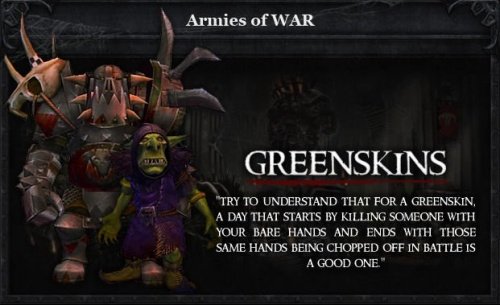
With my melee DPS character out of the way, I wanted to try some of the ranged classes that Warhammer has to offer. First on my list was the aptly named Squig Herder, the Destruction’s ranged pet class. Like many of the class designs in Warhammer Online, the Squig Herder has a unique ability that drastically changes their playstyle on the fly. Called Squig Armor, this ability allows the Goblin player to be swallowed whole by one of their pet squigs while controlling it from the inside of its mouth. Being able to switch from a ranged DPS class to a giant angry meatball at my whim was worth trying out the class alone. I also tried my hand at the Order’s Shadow Hunter, the Elf equivalent of the Squig Herder sans an animal companion. The Shadow Hunter swaps between stances, including a ranged stance for sniping, a melee-oriented stance, and a short-ranged stance as well. Finally, I tried my hands at the Warrior Priest, a melee healing class for the humans. Surprisingly, even the heal-bots have interesting mechanics to juggle while ensuring that their teammates are topped off. The Warrior Priest’s abilities generate Righteous Fury which can be spent on healing spells or buffs, transferring the player’s offense into defense for their party.
If I had any complaint while leveling my various characters, it was that itemization felt strange at times and there weren’t enough reasons to explore my surroundings besides finding a stray public quest across a zone or searching for an opposing player looking to throw down. When a monster drops loot in Warhammer Online, there is a chance that it will not be an item you will be able to use. Since classes are so specialized, both in terms of playstyle and in terms of their equipment, most pieces of gear are only able to be used by specific classes. This means that after an adventuring session, a player may have collected one or two items that they’ll actually be able to use and eighteen others that they can sell as vendor trash. While this felt strange at first, it could just be a case of MMO culture shock since World of Warcraft had me selling just as many gray items to vendors and I couldn’t even trade those off to other players if they really needed them. Theoretically, the design should encourage players to interact, trade, and, hopefully, build connections, but I couldn’t be bothered and ended up selling most of the gear I collected for the spare change they were worth.
Warhammer Online’s streamlined design offers players who are accustomed to World of Warcraft’s quality of life changes plenty of ways to navigate the world with ease. This, however, diminishes the feeling that there is a thriving world out there in the first place, rather than a series of zones connected by flight paths. This isn’t to say that the game lacks areas to explore, but that there just doesn’t seem to be much reason to do it. Thankfully, the landscapes and outposts are well designed both in aesthetics and in function. There’s something oddly thrilling about riding your trusty steed over a demolished siege weapon and up onto the broken wall of an enemy fort or sneaking through a deserted cave to assault the enemy from behind.
After taking a good share of Order and Destruction classes for a spin, I think it’s safe to say that I really enjoy Warhammer. Sure, it has plenty of faults, chief among them that the only way to play it currently is on a private server, but what it loses in graphical fidelity and strange mob pathing/animations, it makes up for tenfold in style, charm, and its overall presentation. For a twelve-year-old PvP-centric MMORPG based on a franchise that has seen better days, Warhammer Online still stands the test of time against stiff competition in the MMO space. The fact that I’m actively playing it over other modern games that I’ve spent a considerable amount of money on is a testament to how well the game was made and how much passion and hard work the community has put into keeping it alive all this time. If you’re willing to delve into the world of private servers, you owe it to yourself to give Warhammer Online a try regardless of whether you’re a returning veteran looking to claim a few more skulls for your throne or an MMO fan looking to sink their teeth into something new.
Star Wars is one of those franchises that I struggle to maintain interest in despite having a deeply held nostalgic attachment to nearly anything set in the galaxy far, far away. Although I successfully avoided seeing the latest mainline episodic movie Rise of Skywalker, I’m only a man and could not resist watching Disney’s The Mandalorian when it was released on their newly minted streaming service. After a series of disappointing films, I was fiending for a television show with a budget set in the Star Wars universe that had nothing to do with the Skywalker family and I just didn’t know it yet.
The story follows a mysterious bounty hunter, called the Mandalorian or Mando for short, who befriends a small alien child. Instead of the series’ signature epic space battleship battles and lightsaber duels, The Mandalorian opts for a more steady-paced adventure with plenty of time to stop and smell the roses. The episodic nature of the show gave plenty of room for the writers to develop specific characters and relationships, something that is often lacking in the films with strictly rationed 2 hours and change runtimes. Like most experiments, what begins as a novelty slowly starts to drag in places, but other than a few episodes that felt more like the plot to a videogame than a TV show, the slower pacing was a welcome reprieve.
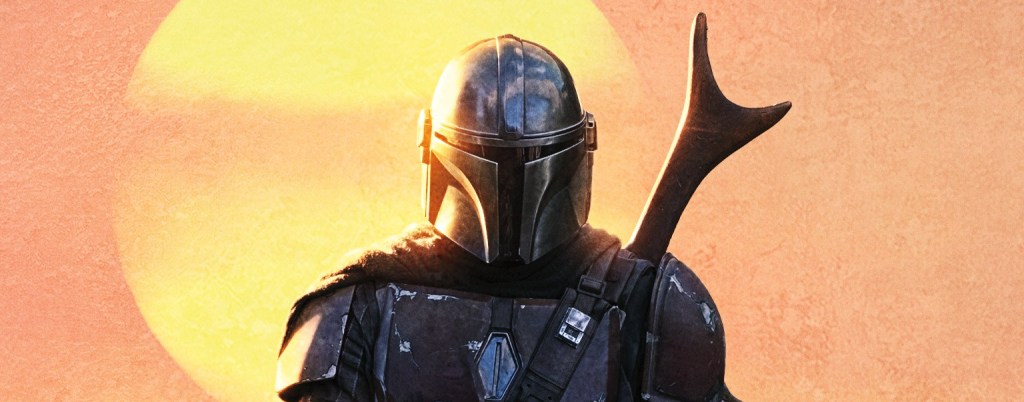
For a show with an anonymous and enigmatic protagonist who refuses to reveal his face from under an ornate helmet, Pedro Pascal puts in a remarkable performance despite the obvious limitations. All of the actors, the nearly perfect casting, and the special effects combine together to fully capture what it would be like to live in the Star Wars universe outside of the sphere of influence of the main story’s protagonists. The set and costume designs perfectly replicate the lived-in sci-fi aesthetic of the classic trilogy while offering plenty of new twists on old themes, such as the designs of each Mandalorian’s individual set of armor.
If you’ve somehow avoided getting swept up in the Baby Yoda and Kuiil memes and have a passing interest in Star Wars, give The Mandalorian a shot. If you don’t enjoy following the adventures of a ruthless bounty hunter turned babysitter after an episode or two, then wars in the stars may just not be your cup of tea and that’s totally acceptable as well. For everyone else, brace for “I have spoken” and “this is the way” jokes during watercooler conversation again as soon as season 2 is revealed.
The Mandalorian is now streaming on Disney+ with a second season currently in the works.
With Bong Joon Ho’s Parasite racking up Oscar accolades and bringing renewed attention to Korean cinema, it felt like the perfect time to watch another film that I’ve had my eye on. Like a good horror movie, Train to Busan explains its premise just enough for us to jump right into the story; an absentee father promises to bring his daughter to see her mother in Busan for her birthday, but not everything is as it seems. Tension begins to ramp up as a sickly woman flings herself onto the train just as it’s about to depart, only to be followed by a swarm of zombies rushing the train platform.
Like Parasite and Snowpiercer, Train to Busan delves deep into the struggles of class and politics while also telling a thrilling tale. In fact, the similarities between the two most popular train-based Korean films to break into the international market are hard to ignore. Both take place on a train and use the convenient separation of the train cars to both physically and metaphorically distance the characters from one another while taking full advantage of the limited space to create an unnerving sense of claustrophobia.
In terms of the zombies themselves, Train to Busan decides to take the World War Z approach of fast, mindless, and twisted undead who trample over one another in a mass of flesh and rapid hunger. This helps keep the characters and the audience on edge, but the world-building isn’t as internally consistent as it could have been. As the protagonist struggles to understand the situation, I also had a hard time stitching together clues to figure out the origin of the outbreak or even the terms on which the plot was progressing forward. For example, there is a scene that involves soldiers falling out of helicopters, only to rise as zombies a moment later and attack nearby civilians that left me wondering if the whole incident was an accident or a direct attack by weaponized zombies.
As the story and train get moving, plot points slowly fall into place and become a lot easier to predict. The occupants of the train are widdled down to a small cast of plucky survivors, including a baseball player, a cheerleader, a pregnant woman, and her husband, and a narcissistic COO of some corporation. Although they fit neatly into archetypal horror movie roles, each brings a personality and charm to the film that helps keep it from being just another zombie gorefest.
Where the story diverts from horror tropes, however, also happens to be the film’s weakest point. For a movie that otherwise left little room for sentimentality, I was surprised at the sharp left turn towards the end of the film that plays more like a Korean day-time drama than an apocalyptic horror flick. It suffices to say that Train to Busan desperately wants to tear at your heartstrings, almost to a melodramatic degree. The dragged out ending with borderline nonsensical character decisions and goofy sentimental moments only helped sour what would have otherwise been an outstanding film.
All that being said, the good aspects of Train to Busan are hard to ignore despite its obvious flaws. It’s a zombie flick with a fun premise, interesting characters, and a great sense of pacing that only falters towards the end, long after you’ve stopped caring about the plot. If you’re a zombie/horror fan or want to explore some of what Korean films have to offer, this would be a hard title not to recommend.
I’m a sucker for a well-executed gimmick, especially films meant to look like they’re filmed in one long shot. Children of Men and Birdman both come to mind as great examples of this style, but rarely have I seen an artistic gimmick so perfectly match its story as with Sam Mendes’ latest creation, 1917. To call it a gimmick is actually a disservice to the emotional weight that it carries in terms of getting the audience intimately familiar with what the characters are experiencing.
Besides the opening scene, which is meant to introduce the single-shot idea as well as the main characters and the relatively simple plot, most of the movie takes place in tight, restrained environments that put the camera directly in the midst of the action. The film does an amazing job of capturing your attention and not getting too caught up in its own brilliance to tell a good story. That is to say, the film’s gimmick is in service to the story, not the other way around (I’m looking at you, Hardcore Henry).
To be frank, I was surprised to like 1917 as much as I did. I knew exactly what to expect going in, yet found myself in awe of the technical marvel unraveling before my eyes rather than trying to catch every hidden cut out of boredom. For a story that is almost entirely “spoiled” in the synopsis of the film, Sam Mendes shows that excellent writing, likable characters, and believable conflict are more important to a good story than subverting the audience’s expectations.
1917 takes very little time in cluing the audience in on just how awful it was being a soldier in the First World War. Although the “good guys” win in the end, the stakes rapidly escalate as our protagonists slog through trenches and into bunkers, facing death at every turn. With the introduction of every new character, you begin to wonder just how much the protagonists can trust them and where their motives truly lay, even those in British uniforms. The tension ramps up to a grand crescendo that both fills you with joy and also rips your heart out from your chest and makes you stare at it. War is hell, alright?
Is this the most important war movie of all time? That’s not for me to say, especially given that I rarely watch war movies outside of the star variety, but I can say that it is easily the best movie I’ve seen so far this year and I’m excited to see it again. Will I be as caught up in the commotion and forget that I’m watching a movie or will the cracks start to show when I’m not spending half of the movie watching over the character’s shoulders for potential threats? That’s hard to say too. What isn’t hard to say, however, is that you owe it to yourself to see 1917 in theaters.