Tag: age of sigmar

  • Death, Destruction, and Chaos – An Age of Sigmar: Warcry Battle Report

    If playing tabletop wargames is your favorite part of the hobby, then you likely play a skirmish game like Warcry or Kill Team. Either provide all of the glory that traditional Warhammer provides at a significantly smaller scale. It’s been around six months since I last played a game of Warcry, so I thought it would be worthwhile to walk through some of what happened on that fateful night.

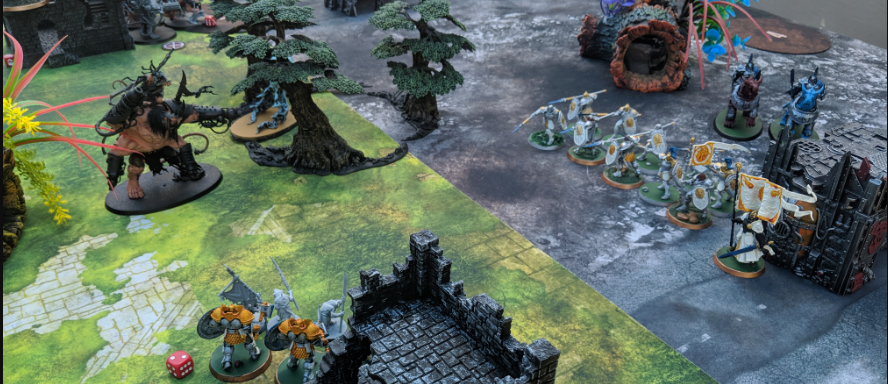
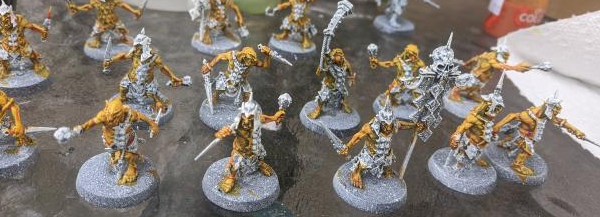
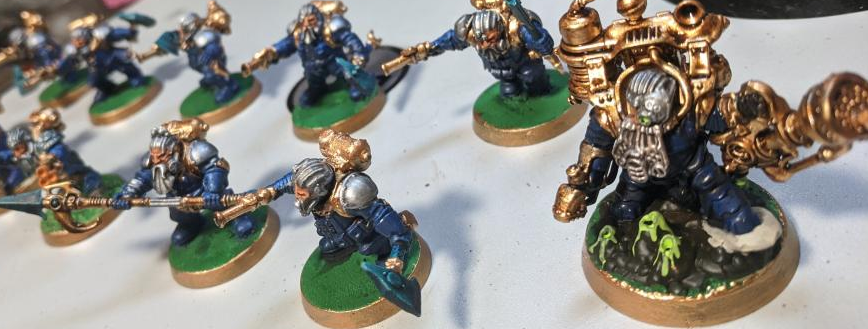
    After work, three of my friends came by to trade Magic the Gathering cards and play Warcry. I set up the board with five objectives and a couples pieces of terrain (unfortunately, I had temporarily misplaced some of my more vertical terrain) and laid out the available warbands for my friends to select. Noah chose his ever faithful Ossiarch Bonereapers, Sam stuck with his Kruleboyz, Alec brought out the Iron Golems, and I represented the Daemons of Nurgle.

    The battle plan was a simple capture and hold objective with the twist that anyone who controls an objective turns it into a healing spring for any nearby allied models. What started out as a patient game of Red Rover turned into a mosh pit in the middle of the board once we all realized that it was going to be the turning point in the game without serious upsets occurring. Alec’s sturdy Iron Golems marched to the center objective first, followed by a skeleton warrior and a Beast of Nurgle. Sam’s Kruleboyz were ambushed by Noah’s Liege Kavalos, which kept them securely in their corner of the battlefield.

    Despite having a ton of wounds, the Orruks were eventually able to fell the Ossiarch leader and begin spilling onto the rest of the board. By that time, however, most of the battle had already taken place. As the Ossiarch retreated, the Ogor Breacher and Beasts of Nurgle continued to clash over the central objective, while the Plaguebearers charging in toe were easily felled by the remaining Iron Golems.

    By the end of the game, the Kruleboyz were able to slink away mostly unharmed but without achieving their ultimate victory of poisoning the local water supply. Their job was done for them, however, as the blighted corpses of the followers of Nurgle piled up around the well and oozed foul bile into the soil. A new dawn rose slowly over the battlefield to reveal the Iron Golems standing victorious over their enemies, unaware that grandfather Nurgle’s wishes had been fulfilled as well.

  • Age of Sigmar Battle Report: Ogor Mawtribes versus Hedonites of Slaanesh

    For today’s battle report, my sparring partner and I decided to test a new Slaanesh list against my new Ogors with Kragnos in toe. Check out the lists below:

    Hedonites of Slaanesh

    • Subfaction: Pretenders
    • 1x Glutos
    • 1x Lord of Pain
    • 1x Contorted Epitome
    • 22x blissbarb archers
    • 5x blissbarb seekers
    • 10x twinsouls
    • 10x pain bringers
    • Terrain feature

    Ogor Mawtribes

    • Subfaction: +1 to spells for butchers
    • 2x butcher
    • 1x icebrow hunter
    • 1x Kragnos
    • 4x mourn fang
    • 2x frost sabres
    • 6x gluttons
    • 4 leadblechers

    We usually come up with the flavor for our match as we set up terrain, so today’s battle involved an Ogor Mawtribe on the warpath coming across Kragnos, the living earthquake, and following him into conflict with a marauding band of Slaanesh’s finest. Half the board being covered in snow helped sell the illusion that the Overwinter had followed Kragnos along with his Ogor companions to their encampment before the battle.

    Round 1: Hedonites

    I was able to win the roll off, deploy first, and gave the turn to my opponent. My goal was to aim for the double turn, and otherwise react to their movement with counter charges. As is typical for the followers of Slaanesh in 3.0, the round started with a pelting of ranged attacks and ended with the pack of seekers killing my leadblechers in one combat. My boys were able to land some nasty unleash hell damage, but otherwise the first turn was relatively uneventful, just as planned.

    Round 1: Ogors

    My turn ended up being much more eventful. Despite my subfaction giving me 2 extra casts, both of my butchers whiffed on all of their spells except for Voracious Maw, dealing a surprise amount of mortal wounds. Not having a terrain feature bit me in the butt for this match, given my list, but I think my models did okay on their own without buffs. A YouTuber once told me to never rely on my spells as an Ogors player and it felt self evident in this match. Thankfully, the remains of my ogors were able to smash into the enemy line and deal a bunch of mortal wounds. Kragnos did his thing, killing the seekers, and my general popped up out of deep strike to send his sabres in to absorb the unleash hell.

    Round 2: Ogors

    Giving up the first turn paid off! I got a double turn and was able to send Kragnos across half the board (10″ move plus a 15″ charge), tackling the Epitome and engaging most of the backline heroes in combat. My hunter was able to breath ice on the archers, charge in, and take a few down before dying himself.

    Round 2: Hedonites

    To his credit, my opponent played out the rest of the round. They finest hour’d their Epitome and went in for the attack, but a finest hour and All Out Defense from Kragnos helped keep him on a +2 despite the rend, nullifying the combat phase for the most part and keeping his army out of range of their mortal wounds on 6 ability. With the Kragnos clapback imminent and him just barely avoiding being bracketed, my opponent conceded and we had a relaxing break afterwards. Sometimes its more fun to talk about Sigmar than to play, but them’s the dice.

    Thanks for reading! If you’d like to read more about Age of Sigmar, game design, or similar topics, check out the rest of the my blog.

  • 5 Lessons 10th Edition Warhammer 40,000 Should Learn From Age of Sigmar

    5 Lessons 10th Edition Warhammer 40,000 Should Learn From Age of Sigmar

    Games Workshop’s flagship tabletop wargames are just as distinct as they are similar. Both games have developed in parallel over the past few years and still have lessons to learn from one another. With Warhammer 40,000’s 10th edition just around the corner, now’s the time to theorize what the new rules set might look like.

    5. Remove the Psychic Phase

    This lesson could just as easily be learned from the success of Horus Heresy’s 2nd edition, but Age of Sigmar similarly benefits from the removal of a dedicated magic phase. Whether you prefer being able to move before or after casting spells, cleaning up unnecessary complexity will go a long way toward making Warhammer a more approachable game for everyone.

    4. Improve Overwatch

    Neither 40k’s Overwatch nor Age of Sigmar’s Unleash Hell are perfect by any means, but the disparity between which models/factions can actually take advantage of their respective anti-charge mechanics shows a clear favor towards the fantasy approach. Unleash Hell allows the defending player to shoot their opponent at a -1 to hit deficit after a successful charge move is made. These two changes in conjunction make for a much more impactful mechanic, but one or the other alone might make Overwatch more than a niche universal strategem.

    3. Adjust Secondary Objectives to be More Reactive

    No plan survives first contact with the enemy, although the current rules for Warhammer 40k wouldn’t show it. Locking each player into three secondary choices from the onset of a match does little to encourage flexibility and quick thinking from players. Age of Sigmar’s Battle Tactics may not be lauded for their design, but they at least allow players to react to what has already happened on the battlefield and change their plans accordingly.

    2. Simplify Morale

    Why Morale involves two separate dice rolls is beyond me. Everyone complains that morale doesn’t matter enough, so having something more similar to Sigmar’s battle shock might help kill two birds with one stone; that or it could just give folks more things to complain about.

    1. Free Warlord Traits and Relics

    Warhammer is always in flux, so this may simply be a symptom of a specific meta-game that we will soon forget. However, 9th edition’s recent change to force players to pay Command Points pre-game to select warlord traits and relics is something I would immediately reverse. Building a list is an engaging part of the process for many different players and forcing them to sacrifice a vital resource to access flavorful aspects of their army is antithetical to allowing players to differentiate themselves and their lists.

    What do you want to see most of Warhammer 40,000’s 9th edition? Let me know in the comments below.

  • 5 Necessary Changes in 10th Edition Warhammer 40,000

    5 Necessary Changes in 10th Edition Warhammer 40,000

    An inexperienced wargamer might be surprised to find that Warhammer 40,000 is both Games Workshop’s most popular game and a complete mess. With decades of success and a devoted fan base, 40k has surpassed every other game in the industry by a large margin. This success has come at a dire cost; legacy rules and mechanics add to the overwhelming sense that Warhammer in space is as bloated and hard to grok as it is compelling to new players. 9th edition introduced a nearly unimpeachable foundation for gameplay and then added more rules and stratagems than any reasonable person has the patience to wade through. With a new edition on the horizon, here are a few suggested changes to make Warhammer 40k more fun for everyone.

    Stratagems

    Similar to Command Abilities in Warhammer: Age of Sigmar, Stratagems offer players abilities outside of their unit’s datasheets. Both games offer a set of universal abilities that all players have access to, but Warhammer 40k leans much more heavily into each player’s individual stratagems. An average codex has two pages devoted to these abilities and it can be difficult for even experienced players to track which stratagems relate to which units or specific gamestates. 

    Solution: Simply expanding the set of universal stratagems, cutting down the overall number, and moving them to specific data sheets will help remove some of the bloat that 9th edition introduced while also making the interesting abilities easier to remember and therefore use effectively.

    Rules Bloat

    Solution: Get rid of 10-20% of superfluous rules and relegate them to a specific game mode, preferably not Matched Play. 

    The main difference between Age of Sigmar and 40k is the degree to which each mechanic helps support the overall flavor of the game and story that the players are trying to tell. Age of Sigmar has fewer rules and better flavor expression, while 40k is extremely bloated and still fails to execute on replicating the lore that makes players start playing in the first place. 

    Number Crunch

    Having to track primary and secondary objective points, command points, experience points, and other various numbers at any given time while primarily using 6-sided dice makes my smooth brain wince. Counting to 100 is an incredibly inefficient use of a player’s time and mental stack.

    Solution: Move the decimal point over one and make numbers smaller and easier to grok. Instead of having 100 point games, make 10 points the maximum instead. This will require the scoring system to be adjusted accordingly, but it will also make the game easier to play without sacrificing anything of value.

    Flavor Expression

    As mentioned previously, Warhammer 40,000 suffers from having incredibly interesting lore and gameplay that fails to live up to the storytelling that precedes it. Factions like the Adeptus Mechanicus and Necron share very similar space mechanically but have drastically different flavor, while the Adeptus Astartes are carbon copies of one another with the exceptions of Space Wolves and Blood Angels. Another ~33% of the model range is devoted to Space Marines but angry, without many shades of nuance in between. Some of the scariest alien menaces known to mankind end up being as weak as wet tissue paper on the tabletop.

    Solution: Of the fewer rules that remain post-debloating, ensure that those rules do a better job expressing the individual faction’s background lore. Differentiate between factions that have similar themes and ensure that everyone has something interesting to do. Reinforcing how the remaining rules express how cool the world of Warhammer 40,000 is would do wonders toward making a better game.

    Skill Expression

    Despite Games Workshop’s best intentions, Warhammer 40,000 is a competitive game with a growing community of professional players. That being said, there are a few mechanics that cause repetitive game states and leave opponents in a situation where they can predict their opponent’s strategy without much agency to do anything about it. Some data sheets provide a jack-of-all-trades profile priced in such a way that makes other similar options inefficient in Matched Play. 40k even offers a few factions stratagems to help players subvert skill testing abilities and just “do the thing!” Letting players do cool stuff is essential, but making them actually do something of note to achieve it will both make their opponents feel better for losing and make the active player feel more clever for having overcome the hurdle.

    Solution: Leaving players with fewer catch-all tools and forcing them to overcome unexpected obstacles will increase player skill expression while reducing the amount of feel bads felt from losing in the same way each match.

    As Age of Sigmar’s development has successfully trended towards simpler, more expressive gameplay, Warhammer 40,000 has several opportunities to learn similar lessons while remaining a distinct game with its own quirks. Warhammer does not need a universal ruleset. Instead, Games Workshop should let the left hand know what the right hand is doing and learn lessons from the development of its other products and other tabletop wargames in general.

  • Warhammer Age of Sigmar: Dominion – 3rd Edition Review

    Tabletop wargaming is my generation’s model train. I grew up going to train conventions with my dad, collected Warhammer 40,000 models in middle school, and admired Warhammer Fantasy from afar for years. It wasn’t until the 2020’s pandemic that I took another look at my miniature collection and regained a love for tabletop wargaming. After a year and a half of learning Warhammer 40k’s 9th edition, I purchased an Age of Sigmar Dominion box and fell head over heels for the modern fantasy equivalent of Games Workshop’s most popular tabletop wargame.

    For context, Age of Sigmar is not Warhammer Fantasy—it is a brand reset for the fantasy version of Warhammer and presents a totally new product despite similar models being used in both games. While Warhammer 40,000 has the baggage of decades of legacy mechanics and rules, Age of Sigmar strips back the bloat and attempts wild and flavorful approaches to traditional wargaming tropes as opposed to the strict interpretations of the 41st millennium. 

    The core rules for Age of Sigmar are relatively simple compared to its contemporaries and help engage the players in the cooperative storytelling that makes for fun gaming sessions. Mortals of the various realms face off against terrifying daemons, horrifying beasts, and followers of chaos alike. 

    Without a ton of rules bloat to lull your brain to sleep (or boredom), Sigmar relies heavily on universal mechanics that all players can take advantage of. The more flavorful abilities are left for specific factions to utilize, but they rarely take center stage in a game primarily around statistics and predictability. This creates a game flow that helps players build up knowledge and familiarity with the game regardless of which force they select to field (the exception being OCR).

    After growing up with old metal models and janky instructions, assembling the models from the Age of Sigmar Dominion box was a breeze! Not only are the models pegged for easy, no-glue-required assembly, but their design is sleek and elegant enough to allow for more experienced builders to trim the pegs off and work with or kitbash the plastic to their heart’s content. If you like the honorable Stormcast Eternals or the slimy Kruleboyz, both armies are a steal at ~$60 each.

    If you’re interested in getting into tabletop wargaming but don’t know where to start, consider picking up the Age of Sigmar Dominion box (they currently sell for around $120 USD) to gain access to two 1,000-point armies that can be played after assembly. If you’d rather try something smaller scale, there’s always Age of Sigmar: Warcry to test your mettle against opposing warbands instead of opposing armies.