Tag: Reviews

  • Joker – Review: A Film About Everything And Nothing

    Joker – Review: A Film About Everything And Nothing

    (Joker – Warner Bros.)

    SPOILER WARNING


    If you haven’t seen Joker yet, there are potential spoilers ahead.

    To tell you the truth, I almost didn’t want to see this movie. With all of the media attention that Joker got prior to its release, I was already tired of the discourse by the time October 4th rolled around. Thankfully, good friends of mine invited my girlfriend and me out to see the film in addition to going to our favorite Mexican restaurant, so needless to say, I was sold.

    It seems like Joker is already a lot of things to a lot of people. For some, it’s a clumsy origin story of a psychotic killer clown from the director that brought you The Hangover 3. For others, it’s a tragedy of how a man with serious mental illness is driven to violence and villainy by a city that neither cares about his wellbeing nor acknowledges his humanity. As for myself, I’m having a hard time coming up with a concise explanation of how I felt given how much was going on during the film. Ultimately, I wasn’t as impressed with Joker as I would have liked, but Joaquin’s performance was nearly worth the price of admission alone and it managed to gain my seal of approval after a solid third act.

    Despite acting as an homage to both Taxi Driver and The King of Comedy, Joker falls short of its inspiration in more ways than one. The idea that it deserved the supposed eight-minute standing ovation Joker got during its initial screening is silly at best, but that being said, it succeeds in exactly what it was meant to do and kept me on the edge of my seat throughout. What might be more interesting, however, is how the film played with my expectations and left me questioning a lot of the assumptions I had made about it beforehand.

    I would be remiss to continue without mentioning that the acting, casting, costumes, set design, and photography for Joker was fantastic. The dark, comic book-inspired 1980s setting helped ground the otherwise comical character firmly in reality. Although it manages a much darker tone than most comic book stories, Joker isn’t without its own laughs sprinkled throughout the otherwise tense and dramatic film.

    It’s hard to say exactly what I expected out of Joker besides a grittier, more realistic take on the Joker’s origin story. Instead of a vat of acid, Arthur Fleck falls into the realization that not everything about his life is as it seems, which combined with severe mental illness, transforms him into the criminal clown that we all know and… love?

    What I wasn’t expecting, however, was just how much time we would end up spending with Arthur Fleck as opposed to his evil alter-ego. Most of the scenes from the trailer show up in the film but reveal something very interesting about Warner Bros. marketing: the trailers want you to believe that the Joker will appear in the film and cause havoc. However, the film shows a different side of the character as Joaquin triumphantly stomps down a flight of stairs only to interrupted by shouting policemen, causing him to skitter away with all of the grace of a looney tune. The Joker we see just doesn’t match up with the genius criminal we’re made to believe he is. In fact, I would say that this Joker feels a lot more like Arthur Fleck playing the Joker than him coming into his own as the Clown Prince proper.

    Once again, spoilers ahead.

    One of my primary issues with the film relates directly to a major plot point. After Arthur Fleck murders three wall street suits on the subway, Thomas Wayne, who is running for Mayor in the film, vaguely compares the downtrodden of Gotham to clowns, which ignites political upheaval as protesters don plastic clown masks and riot. Although the film starts off by establishing the trash strike going on in Gotham, it takes a generous leap of logic to suggest that heaps of trash in the streets, a crappy mayoral candidate, and the random slaying of three businessmen would start a political movement. This shakey connection only helps to muddy the overall message of the film. The riot scenes in Joker felt more like progressive political anti-establishment sentiment filtered through the lens of an aging filmmaker who didn’t really get what all the kids marching on Wall Street were up to years ago but really admired their gumption.

    The twist of fate at the end of the movie where, despite announcing that he was not affiliated with the political riots going on at the time, the Joker is saved from police custody by the protesters rioting in the streets caught me off guard and left me with a lot of questions. Do the protesters recognize Arthur from the television broadcast that was happening simultaneously to the riots? If they do, I can see how killing Robert DeNiro’s character could be taken as a strike again Gotham’s 1%, but I find the the whole connection difficult to believe. Is the ramming of the police vehicle just a random act of violence that happens to result in a crowd forming around a man who was just in a car crash?

    Talking about twists, I wish Joker’s big reveal that his relationship with his girlfriend from the first act was all in head was executed less clumsily. Instead of recognizing the “strange” scenes for what they were, I chalked it up to bad film making rather than an unreliable narrator. Once the idea that what appears on the screen may not be what is actually happening was introduced, things started to make a lot more sense. I’d go so far as to say that the movie should have played with that a bit more. For example, my issues with Joker being retrieved from the police car as a symbolic figure for revolution could be easily explained by the theory that the character we see in “Joker” isn’t Joker himself, but instead Arthur Fleck playing the character from time to time, drifting in and out of his more sinister persona.

    What if we never see Arthur fully become the Joker in this film?

    I don’t know what it says about Joker that I’m having more fun speculating about how it could all make sense given some pretty specific hypothetical fan theories, but hear me out. What if we never see Arthur fully become the Joker in this film? What if, like Fight Club’s unreliable narrator, we only get to see one side of the story? What if Arthur Fleck is to Joker as “The Narrator” is to Tyler Durdan? That might explain how Arthur, a frail, pathetic man transforms into a genius criminal capable of bringing Gotham to its knees. Or, you could believe the fan theory that the director has at least directly mentioned, that Arthur isn’t actually the Joker but a proto-version of the character that inspires the one we know and love. I’d feel cheated if that was the case, given how much marketing went into hyping us up to see the Crown Prince of Crime.

    Unfortunately, this movie doesn’t give me any reason to believe that Arthur would be capable of the kind of mental and physical gymnastics that Joker is most known for. Every event that the populace of Gotham attributes to the Joker is actually caused by Arthur accidentally causing havoc as he flails about, barely managing to stay standing half the time. The slayings that set off the initial protests aren’t some sinister plot to sow seeds of unrest among the people of Gotham. The riots at the end of the film aren’t caused by an insane clown mastermind; they happen because Arthur hides from the cops on a busy subway train. If the goal of this origin story was to subvert our expectations that Joker’s most valuable asset was his intellect, then job well done.

    With all of that in mind, I’m still glad that they tried something different this time around. I was definitely not expecting the approach to the character that they decided on, but it undoubtedly provides a fresh and intriguing look at one of America’s most beloved and feared supervillains. Top it all off with an outstanding performance from the leading actor and you have a movie that’s hard to ignore despite its sometimes sloppy execution.

  • Autobots Roll Out! Transformers TCG Autobot Starter Pack Review

    Autobots Roll Out! Transformers TCG Autobot Starter Pack Review

    I’m a huge sucker for new games. It doesn’t particularly matter whether I am attached to the developer or license. Unsolved games present a dual opportunity for me to explore new puzzles and adopt game design lessons learned to my own projects.

    This past September, Wizards of the Coast and their parent company Hasbro released a brand new trading card game based on the Transformers IP. When I heard the news on Mark Rosewater’s podcast, Drive to Work, my ears immediately perked up. Apparently, WotC brought Mr. Rosewater on board because it had been so long since they had released a new TCG that they needed the guidance of someone with enough experience designing collectible games from the ground up.

    Like many of WotC’s entries into the genre, The Transformers TCG borrows a lot from Magic the Gathering. Cards tap (turn sideways to signify that something has been done to change them in some way), characters attack one another, items are equipped and spells are cast fairly similarly. Even the namesake mechanic, transforming, was also borrowed wholesale from Magic after the Innistrad expansion proved that two-sided cards could be successful outside of Wizard’s other flagship product, Duel Masters.

    178405_200w3b8a7e4883eb78fbde7aefe2261e3902

    That is basically where the similarities end, thankfully. Unlike in Magic, you start a game of Transformers with your favorite set of bots already in play. Players take turns drawing cards, attacking other their characters and upgrading their bots until all of one player’s characters are KO’d. For a game aimed at a younger audience, I was impressed with how much flavor and fun could be packed into a relatively simple design.

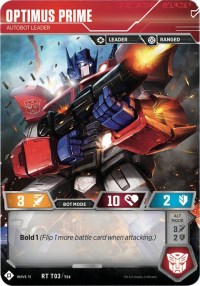
    A mechanic that I particularly enjoy is the ability for each card in the game to offer bonuses in combat, regardless of whether the card itself affects combat at all. When a Transformer attacks, that player reveals two cards from the top of their deck. If the revealed cards have orange pips in the top left corner, they add +1 damage to the bot’s attack. The same is true with Transformers blocking and blue pips. While I’m sure it will play heavily into deckbuilding, at its bare bones, it acts as a workhorse to keep an otherwise simplistic combat system dynamic and engaging.

    file

    My main gripe with Transformers (despite being outside of the target demographic by a significant margin) is that I wonder whether or not the game truly justifies being a trading card game over other popular alternatives. In its current form, players can purchase the Autobot Starter Kit and individual Booster Packs. The Starter Kit comes with enough cards and transformers for one standard deck but also offers an alternative play mode where the deck can be shared with another player for a more simplified version of the game.

    While I appreciate the flexibility, a part of me wonders whether the whole package would have been better off as a living card game (LCG) or something similar where the cards are available for purchase, rather than won through what is essentially a lottery. While collecting is an essential part of games like Pokemon or Magic, the same doesn’t seem to be the case with the Transformers intellectual property. For a franchise about selling an endless amount of toys, the roster of bots doesn’t offer much in terms of a roster for people who aren’t diehard fans outside of Optimus Prime, Megatron, Starscream, and Bumblebee.

    As it stands, I don’t think that I will be purchasing more than the Transformers TCG Starter Kit because I don’t have any interest in chasing rares by buying boosters, a habit that I’ve already had trained out of me in regards to Wizard’s other products. If they end up releasing a more contained product (perhaps a duel deck-style kit with two standard playable decks), then I may be interested in jumping back in to give it a try, but unless I can add it to my growing collection of tabletop games, I don’t think I’ll be participating much in this new trading card economy.

    If you’d like to learn more about the Transformers TCG, you can do so at Hasbro’s website here.