Category: Gaming & Culture

  • 5 Necessary Changes in 10th Edition Warhammer 40,000

    5 Necessary Changes in 10th Edition Warhammer 40,000

    An inexperienced wargamer might be surprised to find that Warhammer 40,000 is both Games Workshop’s most popular game and a complete mess. With decades of success and a devoted fan base, 40k has surpassed every other game in the industry by a large margin. This success has come at a dire cost; legacy rules and mechanics add to the overwhelming sense that Warhammer in space is as bloated and hard to grok as it is compelling to new players. 9th edition introduced a nearly unimpeachable foundation for gameplay and then added more rules and stratagems than any reasonable person has the patience to wade through. With a new edition on the horizon, here are a few suggested changes to make Warhammer 40k more fun for everyone.

    Stratagems

    Similar to Command Abilities in Warhammer: Age of Sigmar, Stratagems offer players abilities outside of their unit’s datasheets. Both games offer a set of universal abilities that all players have access to, but Warhammer 40k leans much more heavily into each player’s individual stratagems. An average codex has two pages devoted to these abilities and it can be difficult for even experienced players to track which stratagems relate to which units or specific gamestates. 

    Solution: Simply expanding the set of universal stratagems, cutting down the overall number, and moving them to specific data sheets will help remove some of the bloat that 9th edition introduced while also making the interesting abilities easier to remember and therefore use effectively.

    Rules Bloat

    Solution: Get rid of 10-20% of superfluous rules and relegate them to a specific game mode, preferably not Matched Play. 

    The main difference between Age of Sigmar and 40k is the degree to which each mechanic helps support the overall flavor of the game and story that the players are trying to tell. Age of Sigmar has fewer rules and better flavor expression, while 40k is extremely bloated and still fails to execute on replicating the lore that makes players start playing in the first place. 

    Number Crunch

    Having to track primary and secondary objective points, command points, experience points, and other various numbers at any given time while primarily using 6-sided dice makes my smooth brain wince. Counting to 100 is an incredibly inefficient use of a player’s time and mental stack.

    Solution: Move the decimal point over one and make numbers smaller and easier to grok. Instead of having 100 point games, make 10 points the maximum instead. This will require the scoring system to be adjusted accordingly, but it will also make the game easier to play without sacrificing anything of value.

    Flavor Expression

    As mentioned previously, Warhammer 40,000 suffers from having incredibly interesting lore and gameplay that fails to live up to the storytelling that precedes it. Factions like the Adeptus Mechanicus and Necron share very similar space mechanically but have drastically different flavor, while the Adeptus Astartes are carbon copies of one another with the exceptions of Space Wolves and Blood Angels. Another ~33% of the model range is devoted to Space Marines but angry, without many shades of nuance in between. Some of the scariest alien menaces known to mankind end up being as weak as wet tissue paper on the tabletop.

    Solution: Of the fewer rules that remain post-debloating, ensure that those rules do a better job expressing the individual faction’s background lore. Differentiate between factions that have similar themes and ensure that everyone has something interesting to do. Reinforcing how the remaining rules express how cool the world of Warhammer 40,000 is would do wonders toward making a better game.

    Skill Expression

    Despite Games Workshop’s best intentions, Warhammer 40,000 is a competitive game with a growing community of professional players. That being said, there are a few mechanics that cause repetitive game states and leave opponents in a situation where they can predict their opponent’s strategy without much agency to do anything about it. Some data sheets provide a jack-of-all-trades profile priced in such a way that makes other similar options inefficient in Matched Play. 40k even offers a few factions stratagems to help players subvert skill testing abilities and just “do the thing!” Letting players do cool stuff is essential, but making them actually do something of note to achieve it will both make their opponents feel better for losing and make the active player feel more clever for having overcome the hurdle.

    Solution: Leaving players with fewer catch-all tools and forcing them to overcome unexpected obstacles will increase player skill expression while reducing the amount of feel bads felt from losing in the same way each match.

    As Age of Sigmar’s development has successfully trended towards simpler, more expressive gameplay, Warhammer 40,000 has several opportunities to learn similar lessons while remaining a distinct game with its own quirks. Warhammer does not need a universal ruleset. Instead, Games Workshop should let the left hand know what the right hand is doing and learn lessons from the development of its other products and other tabletop wargames in general.
  • Magic Lessons for Fighting Game Developers

    Magic: the Gathering’s most prized treasure, Mark Rosewater, presented a panel at CDC called “20 Lessons from 20 Years of Magic.” His speech focused on various aspects of game design lessons that he had learned over his tenure at Wizards of the Coast, but many can apply to fighting games as well. Please excuse me as I loosely paraphrase Mr. Rosewater and cherrypick his lessons that I find specifically valuable. There’s a chance I may have also heard of these on his podcast, Drive to Work.

    Player Psychographics

    Take the player psychographics that Rosewater so often references when discussing the audience for Magic: the Gathering for example. The spectrum of Timmy, Johnny, Spike, and Vorthos is a lens through which you can view anyone, not just card game players. To paraphrase Mr. Rosewater, a Timmy plays to experience something spectacular, a Johnny plays to prove something about themselves, a Spike plays to win, and a Vorthos plays to experience the story. 

    The fighting game community includes more specific player archetypes, but I would argue that we all have a little bit of Timmy, Johnny, Vorthos, and Spike in each of us. Keeping these hypothetical players in mind when designing your fighter will ensure that you’ve done your due diligence to include a wide variety of player perspectives into your work (or not, if that’s more your style!)

    Don’t Fight Human Nature

    At the end of the day, game design is all about conveying and in many ways teaching players complex concepts without ever being able to sit down with them individually. Part of that journey is doing one’s best to pack as much information up-front as possible by utilizing ideas and concepts that the player is already familiar with to ease them into learning about whatever it is that makes your game unique.

    The first step on that path is to acknowledge that you cannot and should not try to fight human nature unless that is the expressed purpose of what you are trying to pull off. Otherwise, it’s best to stick to the familiar when necessary and use that to expect certain responses in return.

    Players have a finite amount of time and a near-infinite inventory of great fighting games to enjoy. Don’t expect a player to want to learn how to ride a pogo stick when they already know how to ride a bicycle, for lack of a suitable metaphor. Only spend those precious mental resources on teaching your players about what makes your game cool!

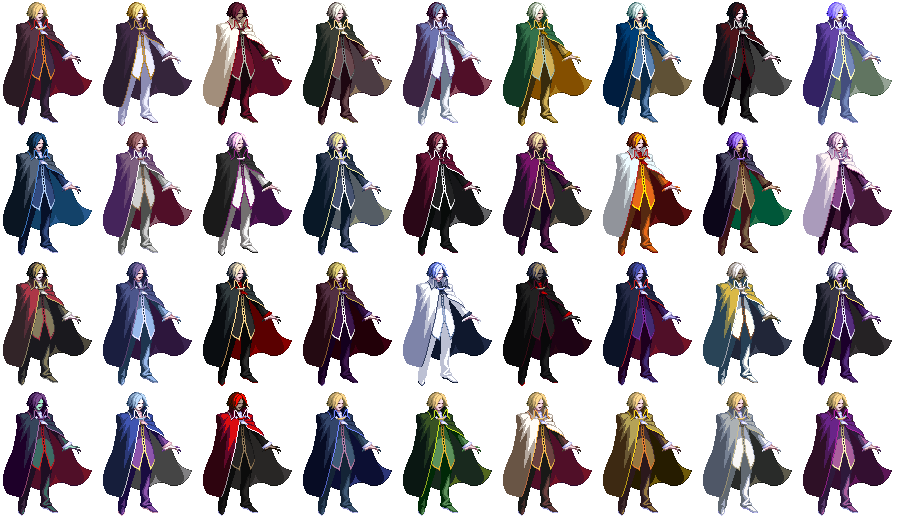
    Look at this selection of vampire colors!

    Discovery & Self Expression Are Vital

    Although it differs among players, a key component to analyzing the player psychographics mentioned above is that each player is, in some part, in it for themselves. That isn’t to say that they don’t care about the other players, but they do ultimately want to express or discover something about themselves. 

    Providing that player agency can be as simple as a variety of color palette choices at character select or as complex as an in-depth combo system that requires years to truly master. Whatever avenue for self expression your game eventually utilizes, being cognizant of what you are providing your audience to discover will make for a more compelling player experience.

    If Your Theme Isn’t At Common, It’s Not Your Theme

    I’ve left this for last simply because it deserves more explanation than the others. Magic: the Gathering separates its cards into a variety of rarities: common, uncommon, rare, and mythic rare. These have differing rates of occurrence in a booster pack, meaning that most players who purchase products from Wizards of the Coast will run into commons way more often than rare or mythic rares.

    These categories offer designers a chance to throttle the player experience and leave more complex concepts or mechanics for rare or mythic rare cards. If a new player runs into a complex mythic rare, that’s okay because it is only one of potentially hundreds of other cards they own, most of which are simple enough to grok without years of experience playing the game at a high level.

    Fighting games are similar, except instead of gating mechanics behind card rarities, fighters have normals, command normals, target combos, specials, ex specials, super arts, super desperation moves, and too many more to list here. Most of a character’s moves are going to be normals—their punches, kicks, and basic martial art attacks. Street Fighter’s Ryu, for example, has plenty of normal moves (Street Fighter is traditionally a six-button fighter), but only three or four special moves, and one to three super arts in his arsenal. Throwing a fireball requires a unique joystick notation as well, leaving some new players left mashing buttons rather than trying to do a 623 motion.

    “Grok?”

    Mr. Rosewater emphasizes in his lessons on card game design that whatever one’s theme is, it should be readily apparent to a new player after confronting their first booster pack of cards. Given that only 3/15 of the cards in any normal pack will be uncommon and 1/15 of them will be rare or mythic rare (although they’ve changed the specific numbers and types of booster packs since I quit playing), that means that 11 of the 15 cards that a new player purchases will be common and, therefore, limited to being relatively simple compared to others.

    In the same way that a Magic set’s theme should be apparent at common, so too should a fighting game’s theme be apparent to players who simply mash buttons and don’t wait long enough to learn how to do a hadouken. If you don’t want players to have to worry about links or precise timing between normals, make your basic attacks chain into one another. If you want to focus on aerial combat, give some fighters grounded normals that leave them airborne. Conversely, if you want a fighter to focus on grounded combat, provide them opportunities to keep their opponent where they are most effective and limit their options to jump. 

    This applies to both universal mechanics and character-specific themes; if your most inexperienced players can’t “get it” after hitting a few buttons, it needs to be better baked into the foundation of the player experience.

    Thanks for reading!

  • When It’s Okay to Go Home Again… Or How to Learn to Love Maintenance Mode

    When It’s Okay to Go Home Again… Or How to Learn to Love Maintenance Mode

    With no end to the pandemic in sight, I’ve found myself delving into MMORPGs in my spare time. Whether it’s Guild Wars 2 or World of Warcraft Vanilla, I always compared them to my time spent in Telera. Eventually, I decided to play my favorite MMO rather than playing games that offer similar experiences with different dressing.

    The question inevitably becomes: “Is the game dead?”

    As much as I loathe the concept of games dying, it’s easy shorthand to describe a game being abandoned by it’s developer and either shutdown or, at best, put into maintenance mode. Rift still has a community of devoted players, making major cities less barren than I expected. Instant adventures are equally as populated, giving players easy access to grouped content. In all other ways, however, Rift can be considered being in maintenance mode.

    Although I wasn’t privy to the events as they occured, it looks like Trion Worlds went under recently and sold the rights of Rift to Gamigo. The new owners seem content in keeping the servers updated and using their limited resources to address community issues, such as recently patching their player report feature.

    If you believe the rumors, I also hear good news about world boss content being experimented with on the PTR. This, combined with the already existing seasonal content, is enough to keep me logging in and checking out the game every once in a while.

    Can an MMO designed to bring players together quickly and easily ever be truly dead? Sure, LFG queues don’t pop as quickly as they used to (or at all) but you can get folks to join you in chat if you’re patient. Instant adventure solves most murder hobo needs, while PVP, crafting, raids, slivers, and chronicles are all still accessible.

    It’s hard to recommend an MMO in maintenance mode without adding a million caveats, so I’ll try to keep this simple. Rift is easily one of my favorite MMOs, if not games, and has a lot of great story and fun gameplay to explore for those looking to find it. If you also want flexible and interesting class choices and build opportunities, plenty of group PVE content, and a unique story/aesthetic, Telera may still have something to offer.

  • Remnant: From the Ashes – Review

    Remnant: From the Ashes – Review

    In a world where every game is at some point inevitably compared to Dark Souls, it’s understandable why it took me this long to give Remnant: From the Ashes a try. “It’s Souls with guns!” people would say to me. I’ve slogged through enough Souls-likes that I need more than just the lure of the next bonfire and relentlessly punishing gameplay to win my attention. Thankfully, Gunfire Games manages to find a graceful balance between drawing inspiration from other games and improving upon the foundation they’ve already set.

    Instead of drawing directly from From Software’s magnum opus, the developers of Remnant cherry-picked the best qualities from the series to adopt and discarded the rest. Gone are the endless corpse runs back from the last bonfire after dying over and over on the same boss. The UI is intuitive and jumping into a game with friends is as easy as pressing one button. There’s even a difficulty rating, a welcome addition to a genre that often misses the point about player experiences.

    A pattern that quickly reveals itself is that Remnant owes just as much to Diablo 2, Borderlands, and similar loot pinata simulators than it does to the Souls series. Chests explode, showering you with crafting materials and ammo. Weapon mods and equipment are easy to mix and match at one’s leisure. Most obtainable items are shared with all players in your party, so there’s no downside to running around collecting everything in sight if that’s up your alley. With an aesthetic that leans closer to Fallout or Deadlands, it’s clear that Remnant borrows a lot from gaming royalty.

    That being said, Remnant: From the Ashes is still very much a Souls-like. Players still dodge roll through enemy attacks, chop off dragons’ tails to craft fantastical weapons, and fight against overwhelming odds to their heart’s content. What is gone, however, is the frustration, alienation of new players, and a tanking frame rate. This game runs remarkably smooth and doesn’t overstay its welcome. 

    Instead of having long branching paths interwoven within one another, Remnant opts for the randomly generated approach. Players could have very similar experiences up until they encountered their first boss, for example. This along with the difficulty rating provide a lot of replay value for players who want to experience more than the main game has to offer or experiment with new gear and weapon mods combinations. For everyone else who just wants to enjoy a short and sweet romp through a dystopian wasteland, I was able to complete the main story in two or three vigorous gaming sessions.

    If you are a fan of Dark Souls and similar titles, then you have probably already given this game a try. However, if you cringe at the idea of dying to hidden traps and wandering off aimlessly only to be eaten by a dragon, then don’t overlook Remnant just because it fits into the Souls-like mold. This might be the perfect introduction to the genre for new players period, both because of how similar to Dark Souls it is and how drastically different it is at the same time.

  • WAAAARRRRGGHHHH – Warhammer Online: Age of Reckoning Review

    WAAAARRRRGGHHHH – Warhammer Online: Age of Reckoning Review

    While I’ve never officially studied law, I recognize the effects that intellectual property rights have had on the preservation of gaming history. This is why I’ve supported private servers for MMORPGs for years, namely because profits stand in the way of maintaining important video gaming artifacts as they were intended to be played. MMOs that have been long shut down by their copyright holders have found new life in private servers that often break the original game’s terms of use. One such game has benefited greatly from the popularity of a private server: Warhammer Online.

    Like many MMORPG projects of the time trying to find their niche, Warhammer Online takes many of the best qualities from its predecessors and adapts them for a more PVP-focused approach. Although I didn’t have a chance to play it on its initial release, I’ve wanted to jump into the world of Warhammer for a long time to see what inspired some of my favorite features from Rift, another MMO from times gone by. Public quests, in particular, piqued my interest, as they offer a unique play experience for players who prefer fighting NPCs rather than players of the opposite faction. Like most theme park MMOs, Warhammer seemingly has something for everyone but appeals specifically to those who heed the call to war and fans of the well-established IP.

    When the game was originally being marketed, a large part of their outreach went into a series of production updates and videos that highlighted their design decisions and delved into specific details for all of the classes and specializations. This was when I originally heard about the project. The first class that jumped straight out at me was the Chaos Marauder, a melee class who specializes in mutating their body into various horrific forms. Similar to stance dancing as a Warrior in World of Warcraft, the Marauder can switch between several mutations to quickly adjust their playstyle. Needless to say, the first toon I rolled up was a Marauder with a giant mutated arm, so I christened him Fisterroboto.

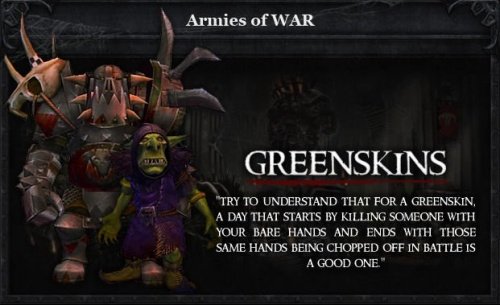
    Chaos mutations sold separately.

    Once I got over the dated graphics, I was absorbed into the world of Warhammer and wanted to explore all that it had to offer. The normal questing experience is very similar to pre-Cataclysm World of Warcraft, asking players to navigate through areas with plenty of monsters to slay, quests to complete, gather resources, and larger obstacles to overcome as a group. What makes Warhammer Online stand apart, however, is the ability to begin PVPing straight out of the gate and teleport around the world to where the action is actually happening. After leveling from 1 to 10 and figuring out how to play a Marauder effectively, I entered a player versus player zone to see what all the fuss was about.

    The War Report offers players the ability to see exactly what is happening on the server at that time and teleport to whatever area or event might interest them most. Seeing that a nearby PvP zone was contested against the Order, I decided to lend my allies aid in battle. After wandering around and sneaking through caves, I found myself teaming up with a few other Destruction players to capture objectives, gather war supplies for our side, and slay oncoming Order players. Although we were outnumbered, my Squig Herder pals and I fought valiantly, using guerilla tactics to target players left out from their group and cut off supply routes for the enemy forces. After gathering a small war band and sieging an enemy watchtower, we were unfortunately defeated by another zerg of Order players. They not only outnumbered us, but they also had plenty of support and healer classes to help keep their melee players alive. After regrouping at the respawn location and trying again a few times, I called it quits and tried a few different classes.

    With my melee DPS character out of the way, I wanted to try some of the ranged classes that Warhammer has to offer. First on my list was the aptly named Squig Herder, the Destruction’s ranged pet class. Like many of the class designs in Warhammer Online, the Squig Herder has a unique ability that drastically changes their playstyle on the fly. Called Squig Armor, this ability allows the Goblin player to be swallowed whole by one of their pet squigs while controlling it from the inside of its mouth. Being able to switch from a ranged DPS class to a giant angry meatball at my whim was worth trying out the class alone. I also tried my hand at the Order’s Shadow Hunter, the Elf equivalent of the Squig Herder sans an animal companion. The Shadow Hunter swaps between stances, including a ranged stance for sniping, a melee-oriented stance, and a short-ranged stance as well. Finally, I tried my hands at the Warrior Priest, a melee healing class for the humans. Surprisingly, even the heal-bots have interesting mechanics to juggle while ensuring that their teammates are topped off. The Warrior Priest’s abilities generate Righteous Fury which can be spent on healing spells or buffs, transferring the player’s offense into defense for their party.

    If I had any complaint while leveling my various characters, it was that itemization felt strange at times and there weren’t enough reasons to explore my surroundings besides finding a stray public quest across a zone or searching for an opposing player looking to throw down. When a monster drops loot in Warhammer Online, there is a chance that it will not be an item you will be able to use. Since classes are so specialized, both in terms of playstyle and in terms of their equipment, most pieces of gear are only able to be used by specific classes. This means that after an adventuring session, a player may have collected one or two items that they’ll actually be able to use and eighteen others that they can sell as vendor trash. While this felt strange at first, it could just be a case of MMO culture shock since World of Warcraft had me selling just as many gray items to vendors and I couldn’t even trade those off to other players if they really needed them. Theoretically, the design should encourage players to interact, trade, and, hopefully, build connections, but I couldn’t be bothered and ended up selling most of the gear I collected for the spare change they were worth.

    Warhammer Online’s streamlined design offers players who are accustomed to World of Warcraft’s quality of life changes plenty of ways to navigate the world with ease. This, however, diminishes the feeling that there is a thriving world out there in the first place, rather than a series of zones connected by flight paths. This isn’t to say that the game lacks areas to explore, but that there just doesn’t seem to be much reason to do it. Thankfully, the landscapes and outposts are well designed both in aesthetics and in function. There’s something oddly thrilling about riding your trusty steed over a demolished siege weapon and up onto the broken wall of an enemy fort or sneaking through a deserted cave to assault the enemy from behind.

    After taking a good share of Order and Destruction classes for a spin, I think it’s safe to say that I really enjoy Warhammer. Sure, it has plenty of faults, chief among them that the only way to play it currently is on a private server, but what it loses in graphical fidelity and strange mob pathing/animations, it makes up for tenfold in style, charm, and its overall presentation. For a twelve-year-old PvP-centric MMORPG based on a franchise that has seen better days, Warhammer Online still stands the test of time against stiff competition in the MMO space. The fact that I’m actively playing it over other modern games that I’ve spent a considerable amount of money on is a testament to how well the game was made and how much passion and hard work the community has put into keeping it alive all this time. If you’re willing to delve into the world of private servers, you owe it to yourself to give Warhammer Online a try regardless of whether you’re a returning veteran looking to claim a few more skulls for your throne or an MMO fan looking to sink their teeth into something new.