Category: Reviews

  • AutoChess Review – A Refreshing Blast from the Past

    AutoChess Review – A Refreshing Blast from the Past

    If you would have told me that a Chinese mobile game would be my latest obsession only three months ago, I would have had a hard time believing you. Sure, I’ve dabbled in mobile gaming before, but I usually prefer to play puzzle games like Sudoku or Picross over more complex games. Then, Auto Chess caught my attention.

    I just so happened to be browsing Twitter one fateful day when I read a Tweet about a popular DotA 2 mod turned mobile game. Players were arguing that Value and Riot Games shouldn’t be so quick to copy the hard work of devoted modders by releasing their own official Auto Chess game modes. Word through the grapevine was that anyone who respected the hard work of the mod community (e.g. me) should support the official version of Auto Chess released by Dragonest Co. Eager to try it out, I downloaded the app on my phone and dug in.

    Not only is Auto Chess essentially an old Warcraft 3 map brought back to life on my smartphone sixteen years later, but it’s also a fantastically addictive mobile game to boot. Those two things are exactly what I need in my life right now, as weird as it sounds. One of my favorite aspects of the Warcraft 3 modding community that I sorely miss is the propensity towards designing games that essentially play themselves. This, combined with the theme of snowballing power creep brought me immediately back to playing custom maps on Battle.net.

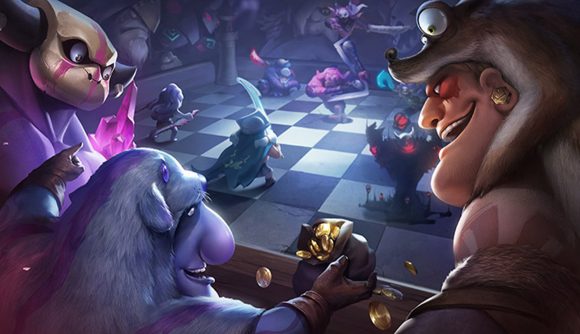
    Since the game was originally developed as a DotA 2 custom mode, each “chess” piece is based off a hero from Defense of the Ancients. If you’ve spent any time playing either DotA Allstars or DotA 2, you’ll feel right at home in Auto Chess. If you haven’t, don’t worry; the game is actually quite simple once you get the basics.

    In Auto Chess, you select a chess piece from among a random selection of five different pieces each round. You place pieces on the board and at the start of every round the pieces you’ve played come to life to fight against either another player’s pieces or a selection of A.I. controlled “creeps.” Sometimes these creeps drop items which you can equip to specific chess pieces. Each chess piece has a role, similar to their DotA counterparts, and both a race and a class associated with them. These identifiers make up the core mechanic of Auto Chess, and essentially boil down to a game of mixing and matching colored symbols. Combining chess pieces of specific races or classes provides your whole team with special bonuses. You can also combine three or more of a specific type of chess piece to upgrade their rank and increase their stats.

    If you can understand a gambling game about matching up three of a kind, you can play Auto Chess.

    Some of my favorite aspects of Auto Chess are also tied directly to its design towards mobile. For example, I get a great sense of pride from performing well enough in Auto Chess that I can actively ignore my phone and know I still have a good chance of winning the match. It’s also handy to not have to constantly be paying attention to a mobile game since you are encouraged to play them on the go and are therefore more prone to being interrupted.

    Let’s go back to that hypothetical that I started this all with and flip it around. If you went back to my high school self and told him that I would be playing what was essentially a Warcraft 3 custom map on my phone and having a blast, he would probably be ecstatic. This jenky little mobile game has stolen my heart at a point when I really needed a pick-me-up. Do I think I’ll be playing this game in 6 months? For my sake, I hope not. That being said, I’m having a ball right now and will enjoy the hell out of this ride while it lasts.

    I give Auto Chess 4 George Costanzas out of 5.

  • Autobots Roll Out! Transformers TCG Autobot Starter Pack Review

    Autobots Roll Out! Transformers TCG Autobot Starter Pack Review

    I’m a huge sucker for new games. It doesn’t particularly matter whether I am attached to the developer or license. Unsolved games present a dual opportunity for me to explore new puzzles and adopt game design lessons learned to my own projects.

    This past September, Wizards of the Coast and their parent company Hasbro released a brand new trading card game based on the Transformers IP. When I heard the news on Mark Rosewater’s podcast, Drive to Work, my ears immediately perked up. Apparently, WotC brought Mr. Rosewater on board because it had been so long since they had released a new TCG that they needed the guidance of someone with enough experience designing collectible games from the ground up.

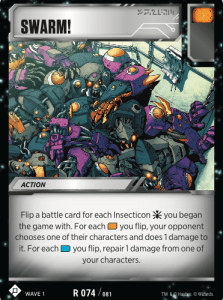
    Like many of WotC’s entries into the genre, The Transformers TCG borrows a lot from Magic the Gathering. Cards tap (turn sideways to signify that something has been done to change them in some way), characters attack one another, items are equipped and spells are cast fairly similarly. Even the namesake mechanic, transforming, was also borrowed wholesale from Magic after the Innistrad expansion proved that two-sided cards could be successful outside of Wizard’s other flagship product, Duel Masters.

    178405_200w3b8a7e4883eb78fbde7aefe2261e3902

    That is basically where the similarities end, thankfully. Unlike in Magic, you start a game of Transformers with your favorite set of bots already in play. Players take turns drawing cards, attacking other their characters and upgrading their bots until all of one player’s characters are KO’d. For a game aimed at a younger audience, I was impressed with how much flavor and fun could be packed into a relatively simple design.

    A mechanic that I particularly enjoy is the ability for each card in the game to offer bonuses in combat, regardless of whether the card itself affects combat at all. When a Transformer attacks, that player reveals two cards from the top of their deck. If the revealed cards have orange pips in the top left corner, they add +1 damage to the bot’s attack. The same is true with Transformers blocking and blue pips. While I’m sure it will play heavily into deckbuilding, at its bare bones, it acts as a workhorse to keep an otherwise simplistic combat system dynamic and engaging.

    file

    My main gripe with Transformers (despite being outside of the target demographic by a significant margin) is that I wonder whether or not the game truly justifies being a trading card game over other popular alternatives. In its current form, players can purchase the Autobot Starter Kit and individual Booster Packs. The Starter Kit comes with enough cards and transformers for one standard deck but also offers an alternative play mode where the deck can be shared with another player for a more simplified version of the game.

    While I appreciate the flexibility, a part of me wonders whether the whole package would have been better off as a living card game (LCG) or something similar where the cards are available for purchase, rather than won through what is essentially a lottery. While collecting is an essential part of games like Pokemon or Magic, the same doesn’t seem to be the case with the Transformers intellectual property. For a franchise about selling an endless amount of toys, the roster of bots doesn’t offer much in terms of a roster for people who aren’t diehard fans outside of Optimus Prime, Megatron, Starscream, and Bumblebee.

    As it stands, I don’t think that I will be purchasing more than the Transformers TCG Starter Kit because I don’t have any interest in chasing rares by buying boosters, a habit that I’ve already had trained out of me in regards to Wizard’s other products. If they end up releasing a more contained product (perhaps a duel deck-style kit with two standard playable decks), then I may be interested in jumping back in to give it a try, but unless I can add it to my growing collection of tabletop games, I don’t think I’ll be participating much in this new trading card economy.

    If you’d like to learn more about the Transformers TCG, you can do so at Hasbro’s website here.