Tag: game dev

  • Merfight Combo Videos – Indie Fighting Game Prototype

    Merfight Combo Videos – Indie Fighting Game Prototype

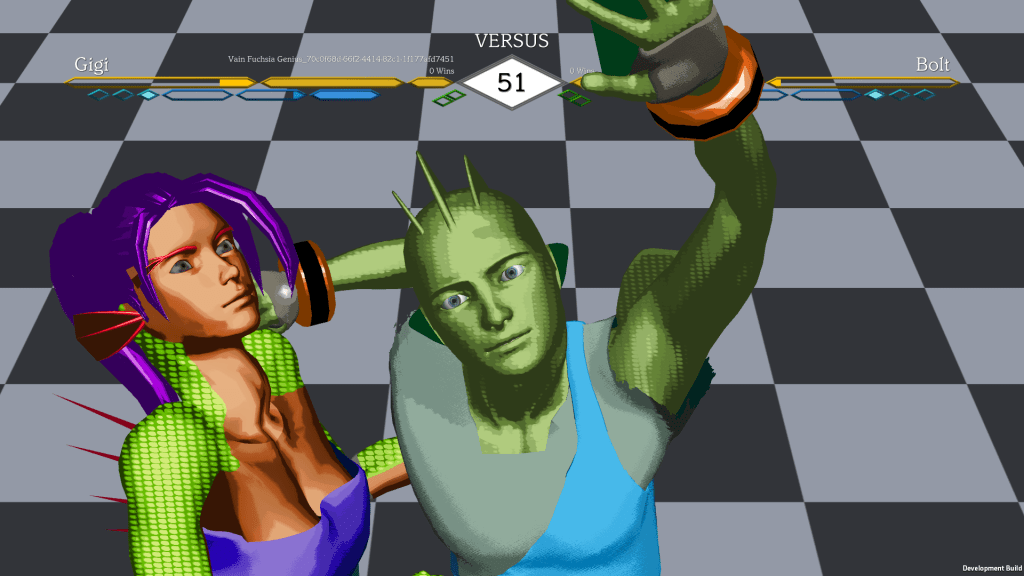
    If I had to describe myself as a fighting game player, I would call myself a lab rat. I enjoy nothing more than to sit down in training mode with a new fighting game and explore the mechanics of combat. This is why it is such a pleasure to be able to play Mattrified Games’ newest 2D fighting game project, Merfight, in an early stage of development. Given the opportunity, I created a few combo videos to demonstrate what I’ve found so far in the 4.1 version of the game, which you can find below:

    Merfight 4.1 Combo Video

    This video covers a few combos for Gigi, Bolt, Strike, and Arctina. I decided to leave Atlas for his own video, which prompted me to create videos for each of the characters. Expect more coming soon.

    Atlas is a really interesting character, especially when it comes to using Rush Gems to cancel his specials and extend his combos.

    Strike is an interesting mix of a rush down character and a grappler. He has great combo potential, but can mix-up his opponents with grab resets as well.

    Bolt is one of my favorite fighters so far. Not only does he have charged versions of his specials, but he has uncharged ones as well, meaning that he can throw out weaker versions of his specials moves while walking or jumping forward.

    Gigi has a lot of tools in her move list including linking normals, repeated wall and ground bounces, repeatable supers, and much more. Check the video out below!

    As a rekka character, Arctina has a very unique feel to her combos. Having an oki trap in addition to strong pokes and pressure means that once she gets a hit, she’ll have interesting oki mix-ups afterward.

    Finally, here’s a little video I made after Matt (the developer) mentioned that he would be introducing damage scaling during combos. I wanted to see what kinds of 100% damage combos were possible and the results were pretty shocking.

    If you like what you see and want to support Mattrified Games, follow him on Twitter @mattrified and check out the game here.
  • The Delicate Balance of Complexity Allowance

    The Delicate Balance of Complexity Allowance

    Game design is often a juggling act involving complexity and the audience’s attention. Every game needs some level of complexity to evoke specific emotions in their players, but humans only have a finite amount of attention that they can (or want to) give to your game at any given moment. Each specific element of a game should be evaluated against the added complexity that it will bring to the overall project.

    This can create issues, however, especially when designers get attached to mechanics or assets that they might be better off cutting. The old adage “kill your darlings” applies to games just as much to creative writing, but it can be hard to quantify exactly how complex any given mechanic or how it’s purpose in the design affects how the idea should be evaluated.

    Another hurdle every designer must eventually cross is deciding whether a specific action is healthier as a player decision. Often, it’s easy to get caught up in a cool sequence of actions and lose sight of the overall vision. Those moments have their place, but it’s also important to weigh the value of that decision point against the player’s overall attention. Is the player overwhelmed with choices? How does this affect the player’s experience? What is the reasoning behind this specific sequence? If the player already had enough to keep track of, adding another decision for them could ruin the experience, no matter how interesting or cool the resulting action could have been.

    The goal isn’t always necessarily to simply things either. Decisions represent significant points in gameplay, moments that test the players skills and understanding. Throw too many of these at a player and they can start to feel discouraged, if not completely turned off, by the added opportunity. Humans don’t like messing up, especially when other people are watching, and no matter how you frame the question, there will always be a “right” and “wrong” answer, or at least the player will see it that way. The more questions, the more potential chances for them to embarrass themselves.

    Sometimes it’s better to force the player to perform the desired outcome, rather than give them the chance to fail. Other times, creating mechanics that specifically check the players ability to overcome a challenge is the way to go. It’s a blurry line at best.

    Recently, I went through the entire design document for my latest project with the intention of reducing the overall complexity of the average game state. What I found was that it was relatively easy to cut back on some mechanics, making certain actions simpler or more directed towards their desired outcome. In most cases, I removed superfluous effects that would only really matter once in a blue moon.

    The resulting game should be cleaner, more elegant, and easier to play now that the average game state is less complex and, therefore, easier to grok. Sure, some moves lost a little luster, but it’s a cheap price to pay for the game being more easily approachable. Keep in mind, the first game decides whether a player will keep playing. Making the learning experience as smooth as possible is paramount for creating an experience that players will want to come back to.