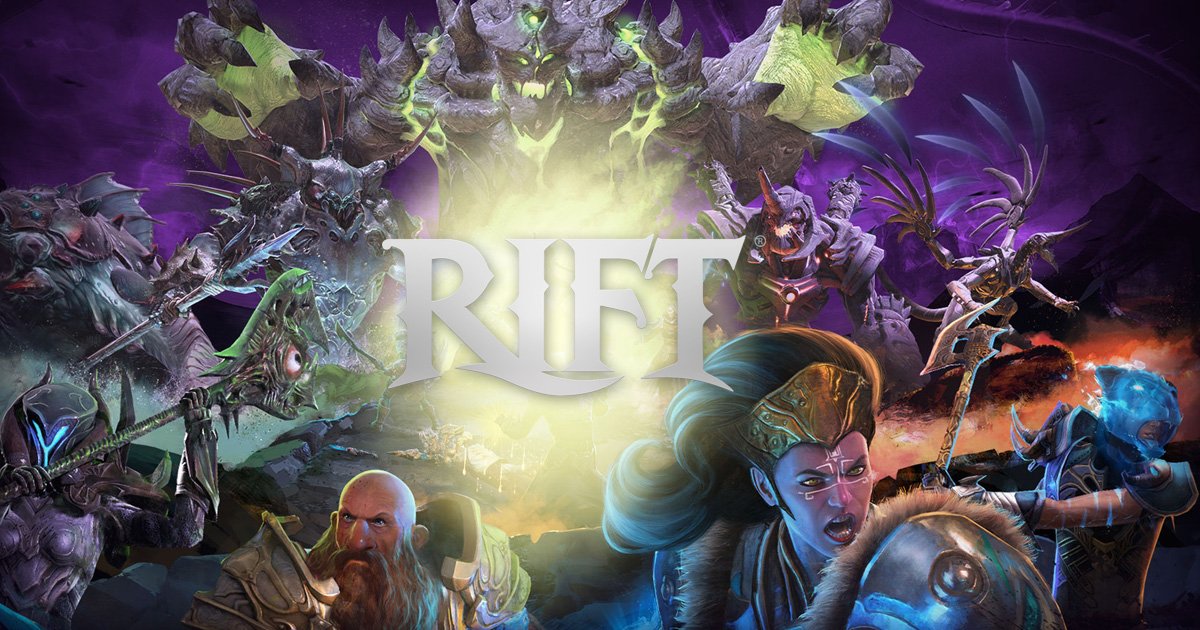
With no end to the pandemic in sight, I’ve found myself delving into MMORPGs in my spare time. Whether it’s Guild Wars 2 or World of Warcraft Vanilla, I always compared them to my time spent in Telera. Eventually, I decided to play my favorite MMO rather than playing games that offer similar experiences with different dressing.
The question inevitably becomes: “Is the game dead?”
As much as I loathe the concept of games dying, it’s easy shorthand to describe a game being abandoned by it’s developer and either shutdown or, at best, put into maintenance mode. Rift still has a community of devoted players, making major cities less barren than I expected. Instant adventures are equally as populated, giving players easy access to grouped content. In all other ways, however, Rift can be considered being in maintenance mode.
Although I wasn’t privy to the events as they occured, it looks like Trion Worlds went under recently and sold the rights of Rift to Gamigo. The new owners seem content in keeping the servers updated and using their limited resources to address community issues, such as recently patching their player report feature.
If you believe the rumors, I also hear good news about world boss content being experimented with on the PTR. This, combined with the already existing seasonal content, is enough to keep me logging in and checking out the game every once in a while.
Can an MMO designed to bring players together quickly and easily ever be truly dead? Sure, LFG queues don’t pop as quickly as they used to (or at all) but you can get folks to join you in chat if you’re patient. Instant adventure solves most murder hobo needs, while PVP, crafting, raids, slivers, and chronicles are all still accessible.
It’s hard to recommend an MMO in maintenance mode without adding a million caveats, so I’ll try to keep this simple. Rift is easily one of my favorite MMOs, if not games, and has a lot of great story and fun gameplay to explore for those looking to find it. If you also want flexible and interesting class choices and build opportunities, plenty of group PVE content, and a unique story/aesthetic, Telera may still have something to offer.
As I’ve mentioned repeatedly before, Rift is one of my favorite MMORPGs. Sadly, I don’t expect to revisit Telara anytime soon, given that the game has long since transitioned to being free-to-play and entered what is effectively a maintenance mode. Another MMORPG has caught my eye, however; I just can’t seem to keep my hands off of Guild Wars 2, especially given ArenaNet recently launched their latest Living World event, the Icebrood Saga. After spending hours reliving my adventures in Tyria, I realized that many of the reasons that I had originally fallen in love with Rift were clearly apparent in Guild Wars’ sequel. Had my favorite MMO been living under my nose all this time? Did my frustration with the changes to the class and skill system in Guild Wars 2 keep me from realizing its brilliance? Either way, let’s jump straight into the top 5 ways that Rift lives on in Guild Wars 2.
5. Group Quests
Let’s get the obvious items out of the way, shall we? Rift’s namesake mechanic involved temporal rifts opening up in the wilderness, each requiring a group of adventurers to overcome and fight back the oncoming horde of baddies. Players didn’t need to join a group or invite strangers into their own party to participate as a community to overcome a common goal. Guild Wars 2 picked up where Rift and other MMOs (Warhammer Online comes to mind) left off, allowing players to jump in and out of quests simply by completing their objectives while sharing rewards with nearby players along the way. Not only does this create a more welcoming and accessible world to play in but it creates a more streamlined experience than the more traditional fetch quests of old.
4. Exploration
Although Guild Wars made a name for itself just fine without a persistent open-world environment, ArenaNet shifted their focus drastically with the sequel to emphasize exploring Tyria. Similarly, Rift implemented plenty of features to keep players from AFKing in their faction’s major city waiting for dungeon queues to pop. Whether it was open world puzzles, group events, or artifact hunting, the ascended of Telara always had some reason to explore the world. This seems like an essential part of any MMORPG, but what Rift and Guild Wars 2 accomplish that many other MMOs fail to do is provide a reason to explore outside of the main leveling experience. It’s an open world out there, so it makes sense to have plenty of things to do in it.
3. Armies of Invaders
In addition to the portals opening up all around Telara, Rift shook things up by having armies of enemies attack nearby towns and cities to disrupt the leveling experience. The idea of world events isn’t new, but when a giant world boss and their army of minions march on your home for the first time, it shows just how cinematic group experiences in MMOs can be. Guild Wars also embraced this as a part of their group questing mechanics. While most quests involve helping out a local farmer or harvesting resources, some involve nearby enemies laying siege to quest hubs or a zone boss killing low-level players en masse. These kinds of moments are what MMORPGs are all about, and the sense of scale and purpose just can’t be matched in other games.
2. Mentoring
MMORPGs, more often than most other genres, carry a lot of baggage from bygone eras. Some games embrace the silliness of endlessly slaying monsters on the hedonistic treadmill we call “grinding,” while others prefer not to shy away from the fact that levels as a concept are outdated. Rift and Guild Wars 2 are definitely the latter, despite the fact that both include level caps that come close to triple digits and leveling experiences that could take a few months to complete. Rift’s answer to the question of leveling was to implement a mentoring system to allow players of different levels to scale their stats to something closer in power level to make adventuring together more fun and engaging. Guild Wars does something similar, except that it is done automatically upon entering a zone, creating a seamless world that most other MMOs fail to achieve.
1. Back to the Action
When you think quick, simple fun, you probably don’t think of MMOs. Some developers have put significant work towards ensuring that isn’t the case, however. Rift, especially later in its lifespan, developed many features under the philosophy of getting players into the action as fast as possible. Their answer, among other things, was to include an Instant Adventure button that quite literally instantly teleports the player to another place and gives them a specific objective to complete with another group of adventurers. Tired of instant adventure? Try some of the singleplayer story content or instanced PVP. Crafting, costumes and other sideshows fill out the usual suite of features for a theme park MMO, but providing content is clearly not the same as guiding the player through it, which both Rift and Guild Wars 2 do spectacularly.
I hope you enjoyed this short romp through memory lane. If you’d like to read more posts like this one or if you remember a specific MMO memory that has stuck with you, feel free to let us know in the comments below.
MMORPGs seem especially prone to building devoted fan bases, leading players towards spending most of their time in one or two virtual world’s that they prefer over others. The original Guild Wars was one of those games that I will forever admire as a landmark in gaming history. ArenaNet pioneered many mechanics that pushed the genre in new and unique directions (focusing more on PVP, showing how silly the leveling treadmill is, singleplayer AI teams, etc).
Once Guild Wars 2 was announced, I admit that I was cautiously excited, but as the game got closer to release and I managed to get my hands on it, that caution quickly turned to disappointment.
Gone was the revolutionary card game-esque skill system, where players selected eight abilities to bring into combat rather than using the same skills as everyone else of that class. Players could no longer select a secondary class to diversify their strategic options. Guild Wars 2, while innovative in its own ways, removed much of what I admired most about the original.
That wasn’t enough to stop me from playing, but it did put a damper on my initial playthrough. I managed to level a warrior and travel through the world but stopped playing after a few months. It took me until 2019 to realize that Guild Wars 2 might be exactly what I need in an MMORPG at this point in my life.
The more I play GW2, the more I realize it’s stunning similarity to my other favorite MMO, Rift. Group quests keep me entertained as I romp through the wilderness with a pack of strangers, monsters attack nearby villages that need defending, exploration is rewarded, the scenery and atmosphere are gorgeous, and the skill system, while not as brilliantly elegant as it’s predecessor’s, is varied and interesting enough to keep me switching up my playstyle every couple of sessions.
The only thing that Guild Wars 2 is missing from Rift is it’s tab targeting and poorly aged questing system, both of which I do not miss dearly (although I am always nostalgic of boar killing-style quests once in a while). I wish there was fishing, but with the addition of gliders and mounts, Guild Wars 2 is just about as perfect an MMO as you can get without installing Guild Wars 1.
There’s this prevailing sentiment among video game players that there is an objective ruler upon which you can evaluate all games. For the rest of us that live with at least one leg firmly planted in reality, we realize that art and entertainment are never that simple. Some games do very well financially to little critical acclaim, while some critical darlings go mostly ignored by the masses. Some games may not even register on your average Forknife tween’s radar, but they may still have had a profound effect on the people who enjoyed them.
MMORPGs are especially difficult to discuss like this due to their temporary nature. Despite what game publisher PR departments want you to believe, you can never go home again, at least not to Azeroth or Telara. MMOs are designed to constantly be in flux, relying heavily on player engagement to make the experience feel whole. I mention this because one of my favorite games of all time was what some in more niche gaming scenes might consider a failure, a fly-by-night World of Warcraft clone that did little more than distract fans until the next expansion by Blizzard.
This summary couldn’t be farther from the truth, as Rift did much more than temporarily steal a portion of WoW’s audience. Trion World’s debut MMO invited gamers into a rich fantasy world with an emphasis on player expression, exploration, and cooperation, at a time when World of Warcraft was dealing with massive blowback from its community about the difficulty of Cataclysm content compared to the WotLK expansion, among other things. Telara wasn’t just Azeroth 2.0, instead offering a welcome alternative that pushed the experience in other directions. While WoW’s cataclysm was revitalizing how traditional questing was done, Rift stuck to a more familiar formula and tried expanding on the core MMO experience instead of reinventing it.
Rift was developed at an interesting time in MMO history, one most memorable for the string of game publishers trying to cash in on the WoW craze just as WoW was waning in popularity and trying to revamp itself. A big complaint gamers had about the streamlining of MMO design was that it often leads to players AFKing in one or two major cities, stopping only to queue into a dungeon or check their auction house sales. Rift’s answer to this was it’s namesake Rifts that opened up throughout the game and offered players an incentive to explore Telara and cooperate with other players to defend it against invading forces.
On paper, this idea sounds revolutionary. In reality, it ended up playing like a slightly more engaging group quest from other, similar titles. But, what it lacked in mechanics it made up for in atmosphere and worldbuilding, both of which are paramount to my experience playing an MMORPG. Sure, you could theoretically ignore the invaders and go about your business, but for those playing for the sake of adventure, it provided a great distraction from the more basic questing system.
Rifts weren’t the only thing keeping players engaged, however. In between the planar invasion and rifts opening up, players could also (eventually) click a button to immediately be grouped together with other players and thrust directly into a group quest, jump into dungeons, raids, and smaller raid-style encounters. They even eventually offered more casual players access to raid content through more intimate encounters using similar assets and environments. Essentially, if you were a PvE MMO fan, Rift probably had something for you.
That being said, it did leave a bit to be desired in terms of Player versus Player mechanics. World PvP never seemed as lively as it should, perhaps because the open-world provided much more interesting endeavors than PKing unsuspecting newbs (An Ex Por, y’all), but there were plenty of instanced opportunities to kill your fellow man. Thankfully, I was more than happy to dip my toe in Warfronts before returning to my much more comfortable time murdering A.I. controlled monsters en masse.
For me, Rift was perfect because I was pretty disappointed with World of Warcraft at the time and found a fresh, yet familiar approach to a game genre I had thoroughly enjoyed for more than a decade at that point. It was obviously not for everyone, but I hope that people give the game a chance despite the fact that it will probably never live up to my fond memories of time spent in Telara.

 tommgoldrick.com